Wednesday, October 29, 2014

Mies van der Rohe sued -- October 29, 1951

Farnsworth House (www.e-architect.uk)
In his 1974 book Mies van der Rohe at Work Peter Carter wrote of Farnsworth House in Plano, Illinois:

The tranquil pavilion of steel and glass, from which every seasonal change may be observed, is poised above the ground and kept usually open to the landscape.  In its relationship to the natural surroundings, there exists no suggestion of a contrived formal composition;  indeed, the building’s occurrence in the landscape would seem almost fortuitous were it not for the harmony which has been established between the architecture and the terrain.  Independent, yet at the same time interdependent, this alliance between the organic and the inorganic creates a convincing image for a technological era.

On this date, October 29, back in 1951 everything was most definitely NOT tranquil at Farnsworth House as it sat, uncompleted, while Mies van der Rohe, its architect, and Dr. Edith Farnsworth, its eventual owner, fired lawsuits at one another.

On July 13, 1951 Mies filed a mechanic’s lien foreclosure suit against Dr. Farnsworth for nonpayment of fees.  The doctor did not pay.  Instead, on October 29 she filed a counter-suit in the Kendall County Circuit Court, alleging that the architect had by “fraud and deceit” led her into paying $33,872 more than the original price upon which they had agreed in 1949.

Additionally, the suit charged Mies van der Rohe with negligence in the handling of construction plans and with being less than honest in his accounting of expenses on the project. The suit sought an accounting of all expenses.

The verdict was still out on the architectural value of the home at the time.  The Chicago Tribune ended its article on the October lawsuit by observing, “The Farnsworth house near Plano is reputed to be the only one of its kind, and it has been visited by many of the world’s best known architects.  In reality, it is a one-room, one story structure with flat roof and glass and steel outer walls, constructed around an inner core containing kitchen, heating and sanitary facilities.” [Chicago Tribune, October 29, 1951]

It took until the first part of 1953 before the suit and counter-suits were heard before Master in Chancery Jerome Nelson in Oswego.  Mies van der Rohe’s attorney, John Faisler, presented his client as “an expert in modern design, a teacher and director of architecture at the Illinois Institute of Technology, and underpaid for his work.”

Dr. Farnsworth and Myron Goldsmith in the offices
of Mies van der Rohe (chicagotonight.wttw)
Mrs. Farnsworth was represented by Attorney Randolph Bohrer, his son, Mason L. Bohrer, and State Senator Merritt J. Little.  (Can there be any more appropriate name for an Illinois state senator?)   Papa Bohrer asserted that Mies van der Rohe was not qualified as an architect and that “boosting of the original cost estimate is attributable either to ‘gross incompetence or stupidity of the plaintiff.’” [Chicago Tribune, January 31, 1953]  The name-calling did not end there as the attorney called Mies an “ordinary charlatan and an egoist of the Buhaus school which has committed more frauds upon this country than any other organization.”

Mies van der Rohe ended up winning the lawsuit and collecting his fees.  Dr. Farnswoth ended up living in the glass house for another 20 years.  The two never spoke to one another again.

The affair did considerable damage to the architect’s reputation.  In a scathing critique of the home in 1953 House Beautiful magazine observed –

Does it work? The much touted all-glass cube of International Style architecture is perhaps the most unlivable type of home for man since he descended from the tree and entered a cave. You burn up in the summer and freeze in the winter, because nothing must interfere with the “pure” form of their rectangles—no overhanging roofs to shade you from the sun; the bare minimum of gadgets and possessions so as not to spoil the “clean” look; three or four pieces of furniture placed along arbitrary pre-ordained lines; room for only a few books and one painting at precise and permanent points; no children, no dogs, extremely meager kitchen facilities—nothing human that might disturb the architect’s composition. [https://www.moma.org/momaorg/shared/pdfs/moma_learning/docs/CL_5.pdf]

Despite the lawsuits and the acrimony the 2,215 square foot house in Plano has stood the test of time and the ravages of nature.  It is now viewed as one of the great triumphs of Mies van der Rohe’s career, more or less.


Or is that less is more?

Tuesday, October 28, 2014

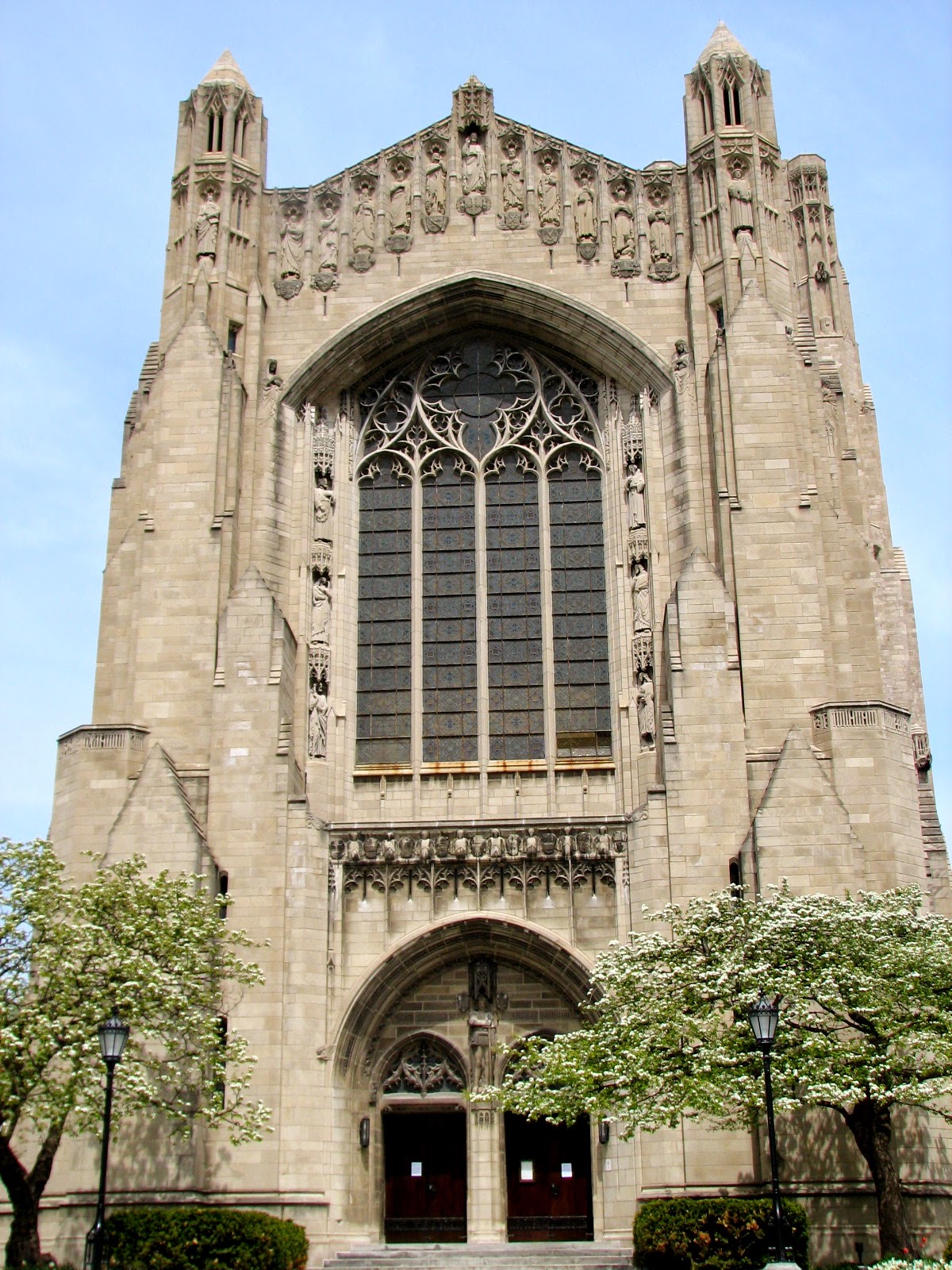
Rockefeller Chapel Dedicated -- October 28, 1928

Rockefeller Chapel Main Entrance (JWB Photo)
“In a ceremony of impressive dignity matching that of the edifice itself, the University of Chicago chapel, the gift of John D. Rockefeller, was dedicated yesterday,” reporter Kathleen McLaughlin wrote in a Chicago Tribune article on October 29, 1928.  The dedication of the chapel on this date came nearly two decades after the great oil baron donated the money to the university for its construction.

Five days before Christmas in 1910 The Tribune reported, “John D. Rockefeller starred for the last time as Santa Claus at the University of Chicago yesterday.”  [Chicago Tribune, December 21, 1910]  This would be Rockefeller’s last gift to the university, a record of generosity that went back two decades to the $600,000 he gave in 1880 to allow the American Baptist Education Society to create the university.  The ten million dollars that was given in 1910 brought the total amount that Rockefeller donated to the great Hyde Park institution to $34,420,049.

JWB Photo
The gift was made known in the form of two letters addressed to the president of the university, Harry Pratt Judson.  According to The Tribune, “The letter from the founder sets forth that Mr. Rockefeller always has desired to have the school as little as possible his institution and as much as possible the university of the people of Chicago and of the west.”  The letter went on to state that it was Rockefeller’s opinion that the school would be better of with “many persons aiding with gifts comparatively small than one person making large donations.”  To underscore his intent he enclosed the resignations of John D. Rockefeller Jr. and Fred T. Gates, his personal representatives on the school’s board of trustees.

The President of the Board of Trustees, Martin A. Ryerson, accepted the Rockefeller gift in a convocation ceremony, saying, “It is the conjunction of the act and the sprit of the act which has made it possible to create and maintain the university, and the trustees hope that through the ages to come the University of Chicago, by training youth in character and in exact learning, and by extending the field of human knowledge, may justify all that has been done by its founder.”

On the following day, December 22, 1928, The Tribune reported that although $8,500,000 of this final gift could be used for any purpose aside from day-to-day operations, Mr. Rockefeller did specifically request that $1,500,000 of the sum be set aside for a chapel “which will be the dominant feature of the campus.”  [Chicago Tribune, December 22, 1910] 

JWB Photo
“It is my desire,” Mr. Rockefeller wrote, “that at least the sum of $1,500,000 be used for the erection and furnishing of a university chapel.  As the spirit of religion should penetrate and control the university, so that building which represents religion ought to be the central and dominant feature of the university group.”

Mr. Ryerson made it clear that it would be some time before the chapel’s construction began.  Mr. Rockefeller’s last donation was to be given in annual installments of a million dollars over a period of ten years.  Before the university used any of the gift, Mr. Ryerson made clear, it would allow the interest on at least the first three installments to accrue.

In that same December 22 issue The Tribune editorialized, “Mr. Rockefeller has closed his accounts with the University of Chicago.  Not a cent more is it to get from him.  That is a wise resolve.  He has done his part nobly.  But for his intelligent generosity Chicago would have had no university, or at least it would not have had one whose rapid growth and whose swift advance to a commanding position among the great educational institutions of the country made it the pride of Chicago.”

JWB Photo
It took almost 20 years to accomplish, but all was in readiness as the chapel, which was designed “to serve all sects” was dedicated “that religion pure and undefiled may dominate all our lives, even as this structure rises above the halls of learning and bestows on them its beauty and strength.”

Representing his father at the ceremony, John D. Rockefeller, Jr. delivered the address that opened the doors of the chapel for which his father had provided the vision and the means to make that vision a reality.

“This building has been made possible by one who is known to the world as a builder of industry, a financier, a philanthropist.  To his son he is known as the most loving, understanding, inspiring father any son ever had,” the younger Rockefeller stated.

The ceremony was an impressive one as Professor Arthur Holly Compton, the 1927 winner of the Nobel Prize, led a procession of 300 faculty members in full academic regalia into the chapel.  Last in line were university president Frederic Woodward and John D. Rockefeller, Jr.  A choir of 150 voices sang O God, Our Help in Ages Past as the procession moved into the nave.

JWB Photo
Seated among the distinguished guests were Mrs. Edith Rockefeller McCormick, the daughter of John D. Rockefeller, Sr.; Miss Muriel McCormick, his granddaughter; Mr. and Mrs. George A. McKinlock, Harold F. McCormick, Mrs. William Rainey Harper, the widow of the university’s first president, and Miss Jane Addams.

Reverend Charles W. Gilkey was installed as dean of the chapel and conducted the service of dedication, concluding his remarks with these words, “It [the chapel] must not be a stone rolled from the ancient hillside, while the stream of life of this university goes around it.  It must be a channel through which that stream may flow, giving it new life and force.”  [Chicago Tribune, October 29, 1928]

Life at this great university does, indeed, flow around and through this impressive Gothic building, a “central and dominant feature” of a university that boasts more Nobel prize winners than any other institution in the world.

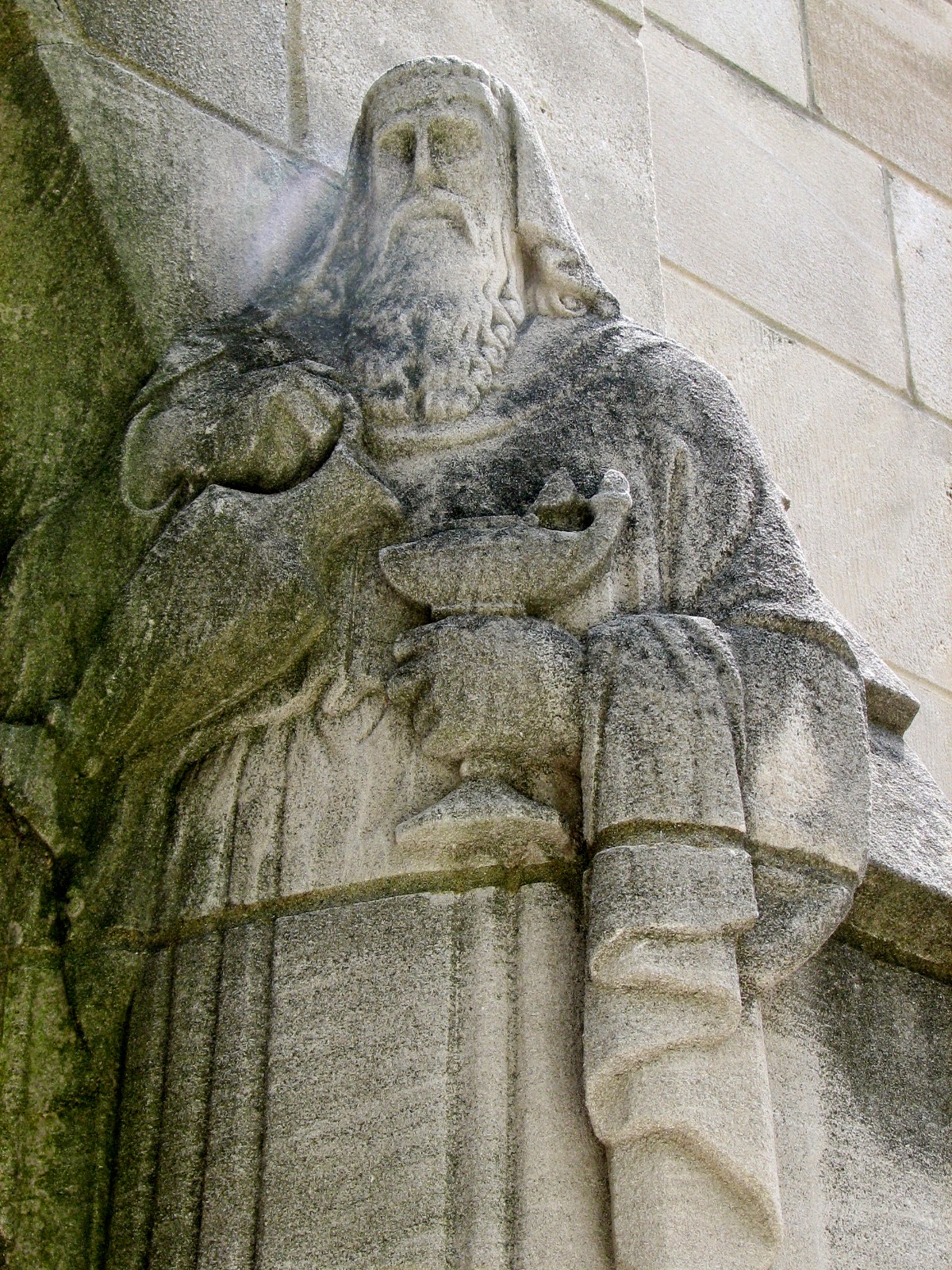
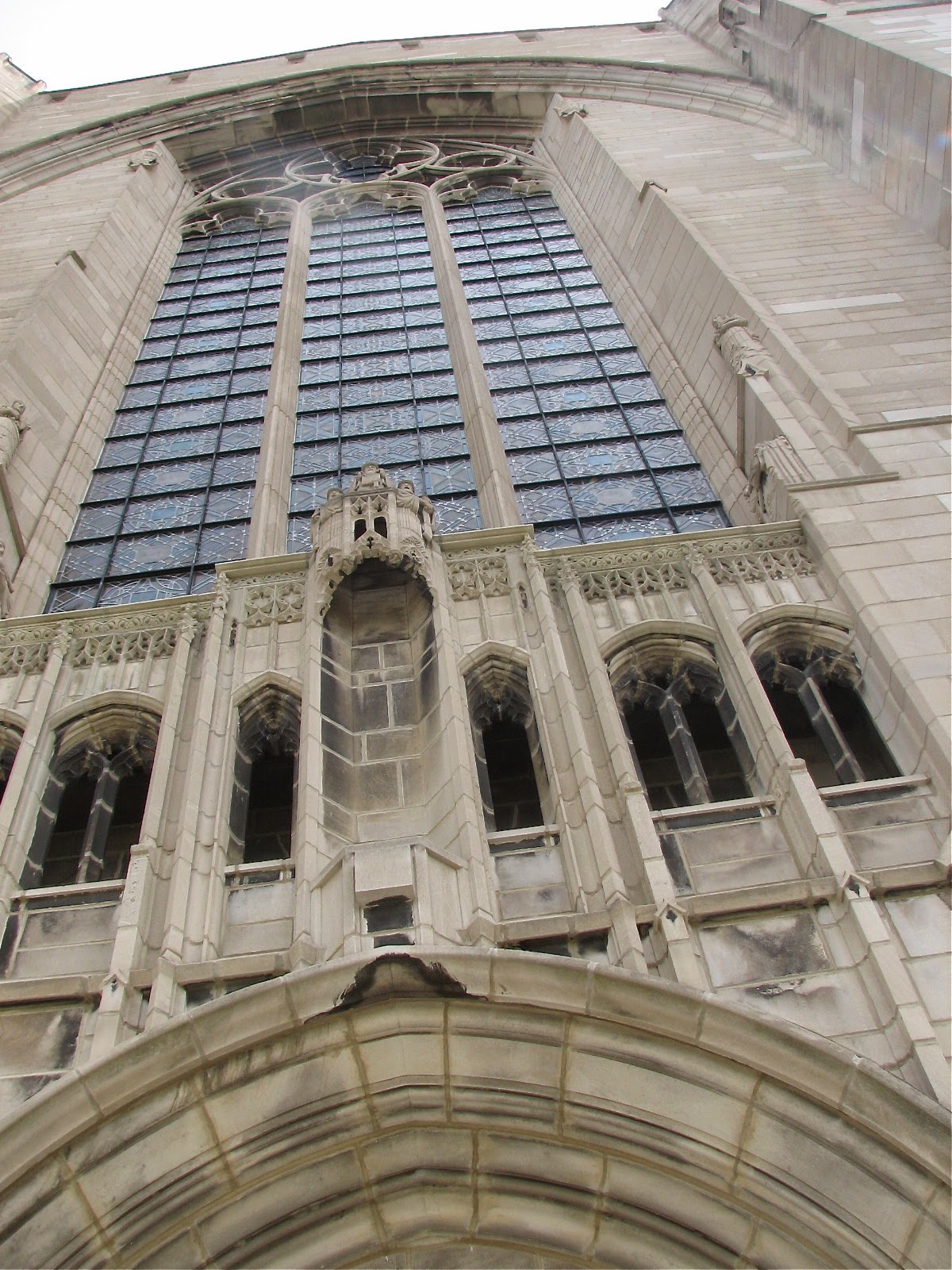
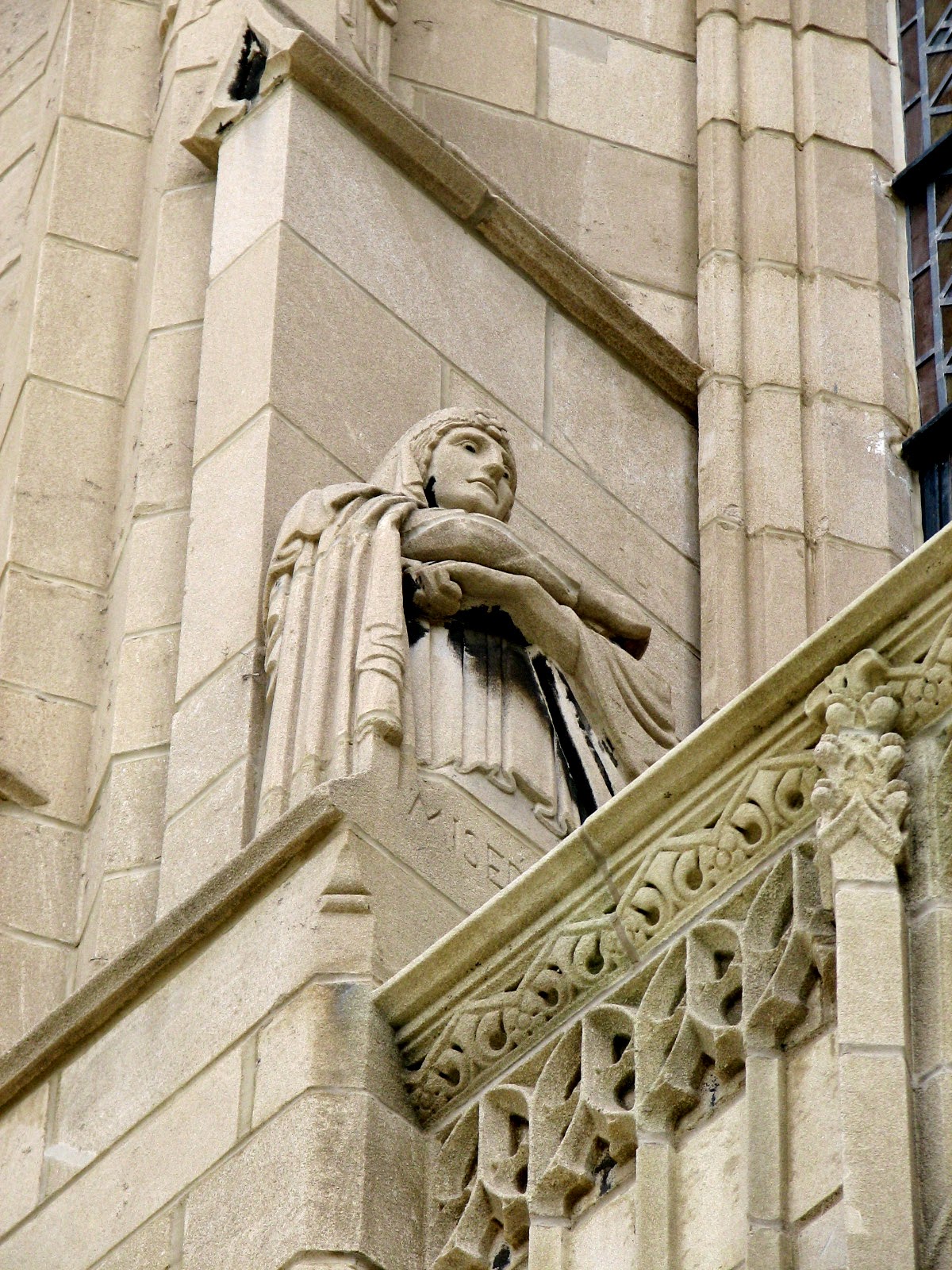
For more on the design and sculptural work of the chapel, you can look here.


Monday, October 27, 2014

Fall in Chicago


I’m afraid that the last warm front is on its way east and with the time changing over the weekend, we are headed for the months that toughen the midwestern spirit and sell lots of window washer solvent.  But it has been a lovely fall . . . the colors have been brilliant, and with so much rain this summer the grass is greener than I can remember it ever being at this time of year.

Jill and I took a walk around the Chicago Botanic Garden a couple weeks ago, and here are some fall pictures that tell the story of just how vibrant these past weeks have been.


Friday, October 24, 2014

The M-10001 Arrives in Chicago -- October 24, 1934


Running on a strict schedule, Union Pacific’s streamlined train, the M-10001, came to Chicago on this day, October 24, in 1934, midway through its record-breaking dash across the continent.  It entered the city limits by skirting railroad yards at Kedzie Avenue at 2:30 p.m., following the St. Charles Air Line to the Sixteenth Street control tower, then backing into La Salle Street Station at 3:00 p.m.  There was no time to waste, and 30 minutes later the powerful train was gone.

Known as the “Canary Bolt,” the M-10001 arrived in New York City at 9:55 a.m. on October 25, just 55 hours after it left Los Angeles, a record that has stood until this day.  Speed was not the only impressive thing about the train.  The six-car train featured a 900-horsepower V-12 diesel engine that supplied power to traction motors driving the first two trucks of the train. 

With its sleek configuration done up in Art Deco detailing and with its economy of operation , it was just a matter of time before the great driving rods of steam locomotives turned no more.

One of the fastest passenger trains of the time, the Los Angeles Limited, used a 120-ton steam locomotive to haul 13 cars of 80 tons each, making a train weight of about 1,160 tons to haul about 100 passengers, or about 160 tons of dead weight per customer.  The M-10001, carrying 52 passengers for the cross-country trip, weighed a total of 200 tons, less than four tons of dead weight per passenger.  The train was designed to carry 124 passengers.  [Chicago Tribune, October 24, 1934]


Built by the Pullman-Standard Company of Chicago, the train consisted of the engine and six coaches coupled together, with cars sharing trucks so that the train was made of a single flexible unit with “unbroken aerodynamic lines for the 376 feet from its bullet nose to its tapered tail.”  [Chicago Tribune, October 22, 1934]

The cross-country dash was designed to work out any kinks in a plan that would install regular thirty-nine and a half hour service between Chicago and Los Angeles.  It was hoped that the cross-country record would be broken, a record that had stood since 1906 when E. H. Harriman, the president of the Union Pacific at the time, had boarded a train after surveying the earthquake damage in San Francisco and sped across the country to New York in seventy-two hours and twenty-seven minutes.  His son, W. A. Harriman, chairman of the Union Pacific board, would be aboard the 1934 train when it left Los Angeles at 10 p.m. on October 22.

“We’ll slice from twelve to fourteen hours from the time made by my father’s special,” said Harriman, “depending upon how well the M-10001 maintains our tentative schedule.”

A crowd of several hundred people watched as the train left Los Angeles and started its charge across the country as the engineer “in a comfortable upholstered chair facing a semicircle of windows atop the rounded nose of the carrier, gentled the charger through the suburbs of Los Angeles.”  [Chicago Tribune, October 23, 1934]    The “diesel-powered tub of aluminum” covered the 144 miles through the Sierra Madre mountains from East Los Angeles to Barstow, California in 3 hours and 6 minutes, cutting through the mountains 90 minutes faster than scheduled passenger runs over the same distance.


It took 23 hours and 46 minutes to cross the “deserts sunbaked by day and moon drenched by night and winding over passes between snow-capped mountains” between Los Angeles and Cheyenne, Wyoming.  That was 11 hours and 12 minutes faster than the express passenger service of the time. 

After leaving Cheyenne engineer Ollie Mitchell was ordered to “’give the gun’ to the 900 horsepower Diesel propelling this shaft of aluminum alloy.”  [Chicago Tribune, October 24, 1934]  On its way to Omaha, Nebraska the train reached a speed of 120 miles-per-hour, a record that still stands.  

To get to New York the streamliner covered 3,034 miles at an average speed of 58.5 miles-per-hour, stopping in Chicago for a half-hour as well as Salt Lake City, Cheyenne, and Omaha.  New York offered it a single indignity before it reached Grand Central Station and the laurels that awaited it.  “The space eater was halted on the outskirts of New York and, to meet a legal requirement, was pulled into the Grand Central station through the long underground rail approaches by an electric locomotive.” [Chicago Tribune, October 26, 1934]

Asked if the new trains would take business away from airplanes and buses, Mr. Harriman responded, “Of course these new trains will compete with the airplanes on long trips.  They will be more comfortable and safer and I don’t know any way to fly between Los Angeles and Chicago without the loss of a business day.”

Things were looking pretty good for the railroads back there in 1934. 


After its record-breaking run and a good will tour throughout the east, Union Pacific replaced the 900 horsepower engine of the m-10001 with a V-16, 1,200 horsepower diesel engine, then put the train into revenue service as the City of Portland, running from Chicago to Portland over Chicago and Northwestern and Union Pacific right-of-way.  The train made the trip in 39 hours and 45 minutes.  “A Chicagoan going to Seattle would have to change trains in Portland and would still arrive nearly 20 hours sooner than if they took the Empire Builder, North Coast Limited, or Olympian.”  [steamlinermemories.info]

Wednesday, October 22, 2014

Goethe Cheers Marathon Runners

           
                                                                                                     JWB Photo

                 The deed is everything; the glory is naught.
                --Johann Wolfgang von Goethe

As the lead runners of the Chicago marathon turn north onto Sheridan Road, nearing the seven-mile mark, Ludwig von Goethe looks on.  The eventual winner, Eliud Kipchoge, is the back runner in the lead pack with the yellow shirt and the fluorescent pink running shoes.  He came home in two hours, four minutes and 11 seconds, averaging well under 4:50 a mile.  Sunday, October 12 was a beautiful October morning in Chicago, with perfect weather for a runner if you discount the stiff wind out of the south.

For more about the Goethe statue, you can look here, here, and here. 


Tuesday, October 21, 2014

Yerkes Observatory Dedication -- October 21, 1897

October 21, 1897 -- Dedication Ceremony for the Yerkes Observatory
(cr.rps.gov)
Attention turned to Williams Bay, Wisconsin on this date, October 21, when a crowd gathered for the ceremony that would dedicate the University of Chicago’s great Yerkes Observatory, featuring the largest refracting telescope that would ever exist.  It was a day of speeches, glorifying both the telescope in its Beaux Arts observatory and the man who made the whole thing possible, Charles Tyson Yerkes.

As is so often the case when the history of Chicago is examined, the story of the observatory is a fascinating study in conflicting impulses that drive people to leave their mark on history and the battle of good and evil that can both canonize and condemn individuals whose reach may sometimes exceed their grasp.  Charles Tyson Yerkes was nowhere near a saint, but the sins of which he was accused ultimately eliminated much of the chaos of Chicago’s surface transit lines and gave a great observatory to the world.

William Rainey Harper
This story begins in July of 1892 when the president of the University of Chicago, William Rainey Harper, invited a young astronomer, George Hale, to join the faculty at the university.  It was a good move for Harper . . . with the 24-year-old came an observatory the young man’s father had built at 4545 Drexel Boulevard and a promise to raise $250,000 in cash within three years to build a bigger observatory.  Young George was, as part of the deal, to be named as the director of that new observatory.

By September the lens of history begins to sharpen George Hale’s ambitions when he learns there are two 42-inch optically perfect lenses that are sitting useless as a result of a deal that fell through.  That deal, brokered by the University of Chicago, had at its heart the construction of the world’s largest observatory in the world atop California’s Mount Wilson.  [atro.uchicago.edu.]

The trick was to find a way to cough up 16,000 bucks to get the things out of hock.  A willing benefactor turned up in October as Hale and Harper drop in on Charles Tyson Yerkes at his office at 444 North Clark Street on October 4, just three days after the university officially opened its doors.  [Franch, John.  Robber Baron:  The Life of Charles Tyson Yerkes.  University of Illinois Press:  2006]

Promising that the telescope would be the largest in the world and that, with a little luck, it might even be ready in time to be displayed at the great World’s Columbian Exposition in 1893, the two men convinced Yerkes to foot the bill.

Charles Tyson Yerkes
“Gentlemen, go ahead and build the finest telescope on earth and let it be equipped with everything that is needed to make it the best,” Yerkes is supposed to have said.  “When you have it all finished send the bill to me and I will pay it.  Never mind the question of cost.”

Unfortunately, a sum was mentioned in the meeting on Clark Street – somewhere around $60,000 for the telescope and the frame on which it would be mounted.  You can’t blame Yerkes (and he can be blamed for a lot) for figuring that was the figure that he would eventually owe.  Perhaps, more unfortunate was that there was no mention in the meeting of the building that would eventually be needed to house the massive piece of apparatus.

The question of the building become a good-sized problem by January of 1893 when Harper received a letter stating that without knowledge of the final site for which the telescope was intended, the piece could not be finished in time for display at the fair. With time sliding past, a site just outside Lake Geneva, Wisconsin was chosen after a group considered candidates from Highland Park to Peoria.  

You can imagine Mr. Yerkes’s reaction.  Facing significant criticism in Chicago because of his heavy-handed – some might say less than legal – methods of doing business, the railroad magnate was probably hoping the telescope would deflect a galaxy of criticism and underscore the magnificent generosity of a gift that placed Chicago second-to-none in the world of astronomy.  But the great observatory would be sited in farm country, 80 miles north of the city, and it would take a significant amount of effort to get there to hold the grandiosity of the railroad baron's gift.

Construction of the dome of the Yerkes Conservatory
(atlasobscura.com)
In any event, the great telescope was somehow completed for display at the Great Fair.  It was massive.  Mounted on a base that stood 43 feet high and weighed 50 tons, the six-ton telescope towered above fairgoers in the Manufactures Building.

Even before the telescope was finished, though, the relationship between William Rainey Harper and Yerkes began to deteriorate.  Yerkes had certain goals for his traction empire and was willing to do almost anything to achieve them while Harper, as a prominent member of the Civic Federation, was complicit in efforts by that group to curb corruption in the rapidly growing city.  Ultimately, though, Yerkes wrote checks for $285,000 to cover the cost of the greatest observatory in the world.

Despite the animosity, though, by  October 21, 1897 the observatory was ready for dedication.  With a design by Henry Ives Cobb, who had done so much work at the new University of Chicago campus in Hyde Park (you might also want to check out the Chicago Athletic Association Building on Michigan Avenue, the Newberry Library at Clark and Walton, and many of the pre-1900 buildings at Lake Forest College), the observatory had all of the classical touches that would have appealed to Yerkes’s personal desire to impress all who beheld it.

Two trains carried over 700 people from Chicago to the ceremonies, which began with “the august company of the college fathers,” entering the observatory dome room in a long procession.  Over 50 astronomers filed in along with distinguished guests from around the country.  Last in line were President William Rainey Harper and Charles Yerkes.

A quartet played Tschaikowsky’s Andante, at which The Tribune observed, “The acoustic properties of the dome room were not all that could be wished for appreciating the performance of the quartet, but it was pleasing, nevertheless, and was roundly applauded.”  [Chicago Tribune, October 22, 1897]

Details of John D. Rockefeller and
William Rainey Harper in the Beaux Art
stylings of Henry Ives Cobb
 
After a rousing lecture, The Importance of Astophysical Research and the Relation of Astrophysics to Other Physical Sciences, President Harper rose to accept the gift of the observatory and to recount the struggles it took to create the observatory and the reasons for choosing Williams Bay as the site for the telescope, disclosing that 26 different locations were considered before the choice was made.

Then, turning to the man who had made it all possible, President Harper said, “We realize that you have greatly increased the glory of the university by furnishing an equipment which makes it possible to discover new and important facts in the structure of the universe . . . that you have honored the City of Chicago, the Northwest, the entire Valley of the Mississippi, by planting in its midst an institution which through the centuries will contribute to the uplifting of men and the upbuilding of character.  We appreciate above all the simplicity and the sincerity of the motive which prompted you make this gift and the purpose which has controlled you throughout these years during which the gift has taken tangible form.”

Charles Tyson Yerkes listened.  He probably had a lot to say, but he did not speak.

The Yerkes Observatory is still in operation at its original location.  You can learn more about it here.